Skip to content
|12 min read

European Lace Types: A Bride's Complete Guide to Chantilly, Alençon, Guipure, and Beyond

Amalya Cohen
Amalya CohenDesigner & Founder
European Lace Types: A Bride's Complete Guide to Chantilly, Alençon, Guipure, and Beyond

Lace is the language of bridal couture. Long before beading, before embroidery, before the first stitch of a bodice, the lace tells you what kind of gown you are looking at. A centimeter of fine Alençon reveals centuries of French craftsmanship; a panel of heavy Venetian guipure announces architectural drama; a fall of Chantilly whispers romance. For a modest bride, lace carries even more meaning — with long sleeves and high necklines, there is simply more of it on display, and every thread is visible in photographs, in sunlight, and across a lifetime of anniversaries.

This guide is a complete education in the European laces that define couture bridalwear. We will cover origin and technique, the characteristics that separate couture-grade from commodity, where each lace belongs on a modest gown, and how to identify quality when you hold a sample in your hands. At AMALYA, our designer Amalya Cohen works with exclusive hand-woven lace patterns commissioned from European mills — patterns that appear nowhere else in the world. What follows is the knowledge we use every day when sourcing and designing.

What Makes Lace "Bridal-Grade"?

Not all lace belongs on a wedding gown. The difference between bridal-grade lace and ordinary lace begins with fiber. Couture bridal lace is woven from fine cotton threads, silk, or high-grade viscose that imitates silk's drape — sometimes in blends that combine the strength of cotton with the sheen of silk. Polyester lace, by contrast, tends to feel flat, refuses to take a natural dye, and photographs with a plastic glare under direct light.

The second distinction is weight and drape. A bridal lace must have enough body to hold a scalloped edge, to follow the curve of a sleeve, and to settle against a bodice without puckering. Too light, and the lace floats away from the fabric beneath it. Too heavy, and it overwhelms the silhouette. Experienced couturiers learn to judge lace weight by its fall — hold a yard by one edge, and a good bridal lace will settle into gentle folds rather than stiff creases or limp sag.

The third consideration — and the most critical for modest bridalwear — is opacity. Much of the lace sold today is designed to be worn against the skin, which is precisely what a modest gown cannot do. At AMALYA, every lace we use is chosen for how it behaves once lined: the pattern must remain crisp against a skin-tone or ivory underlay, without the underlay bleeding through the motifs. Truly sheer laces are rejected outright, no matter how beautiful the pattern, because they cannot meet modest coverage standards.

Finally, and perhaps most importantly, there is the question of hand-woven versus machine-made. Machine-made lace has existed since the early 19th century, and modern Leavers and Jacquard looms can produce remarkably fine work. But truly exceptional bridal lace is still woven by hand or on heritage looms operated by master craftsmen, with patterns that are refined over decades. AMALYA's laces are commissioned exclusively from such European mills — patterns that exist in no other collection in the world.

Chantilly Lace — The Romantic Classic

Chantilly lace takes its name from the town of Chantilly in northern France, where it was first produced in the 17th century and perfected in the 18th under the patronage of the French court. Though most Chantilly today is actually woven elsewhere in France and in Belgium — Chantilly as a place ceased to be the primary production center long ago — the name endures as a standard of style.

True Chantilly is immediately recognizable. It has a fine, hexagonal mesh background with floral motifs worked in flat, untextured thread. The outlines of the motifs are traced in a slightly heavier cordonnet thread, giving the pattern definition without raising it from the ground. Traditional Chantilly features naturalistic flowers — roses, lilies, scrolling vines — rendered with a delicacy that reads as pure romance.

Chantilly is the lace of soft, romantic silhouettes. It drapes beautifully, which makes it the preferred choice for overlay gowns where a full lace layer is suspended over a silk or satin base. It is the classic veil lace — long cathedral veils in Chantilly have been worn at royal weddings for three centuries. On a gown, Chantilly excels as an all-over overlay, as a delicate sleeve fabric, or as an appliquéd detail where the scalloped edge can be cut and applied by hand.

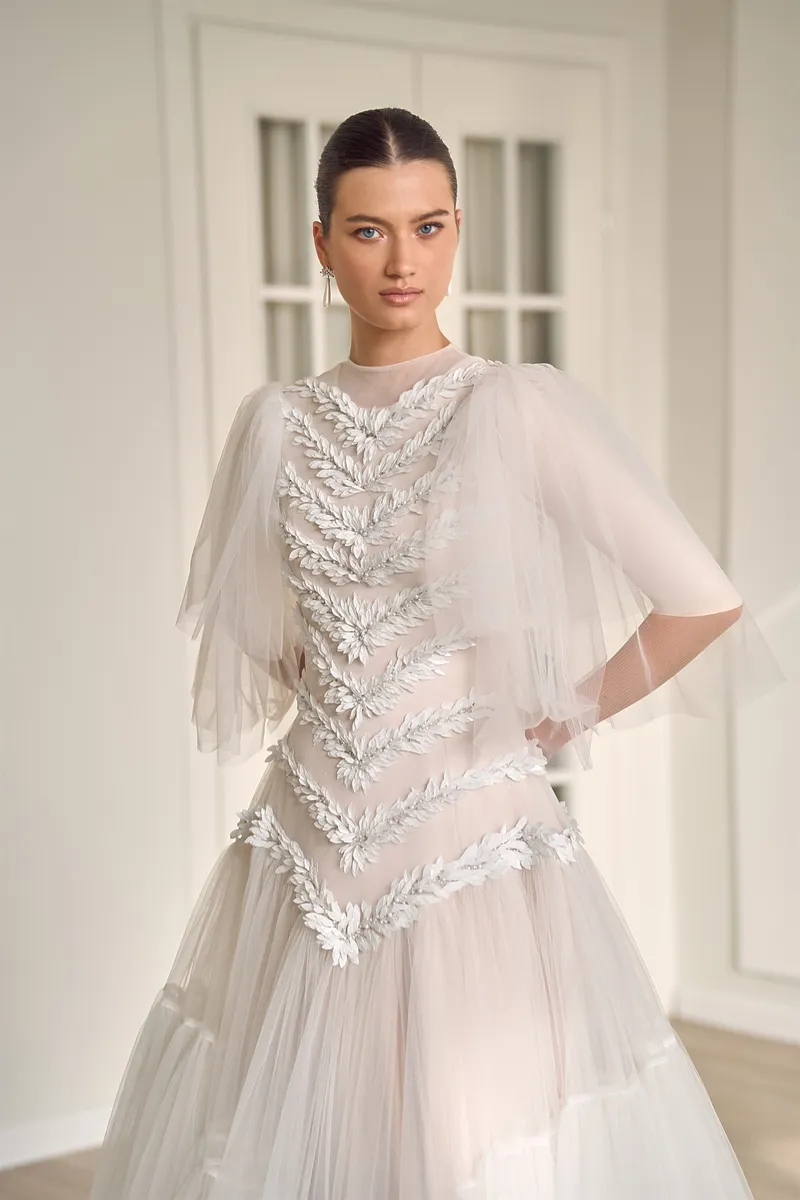
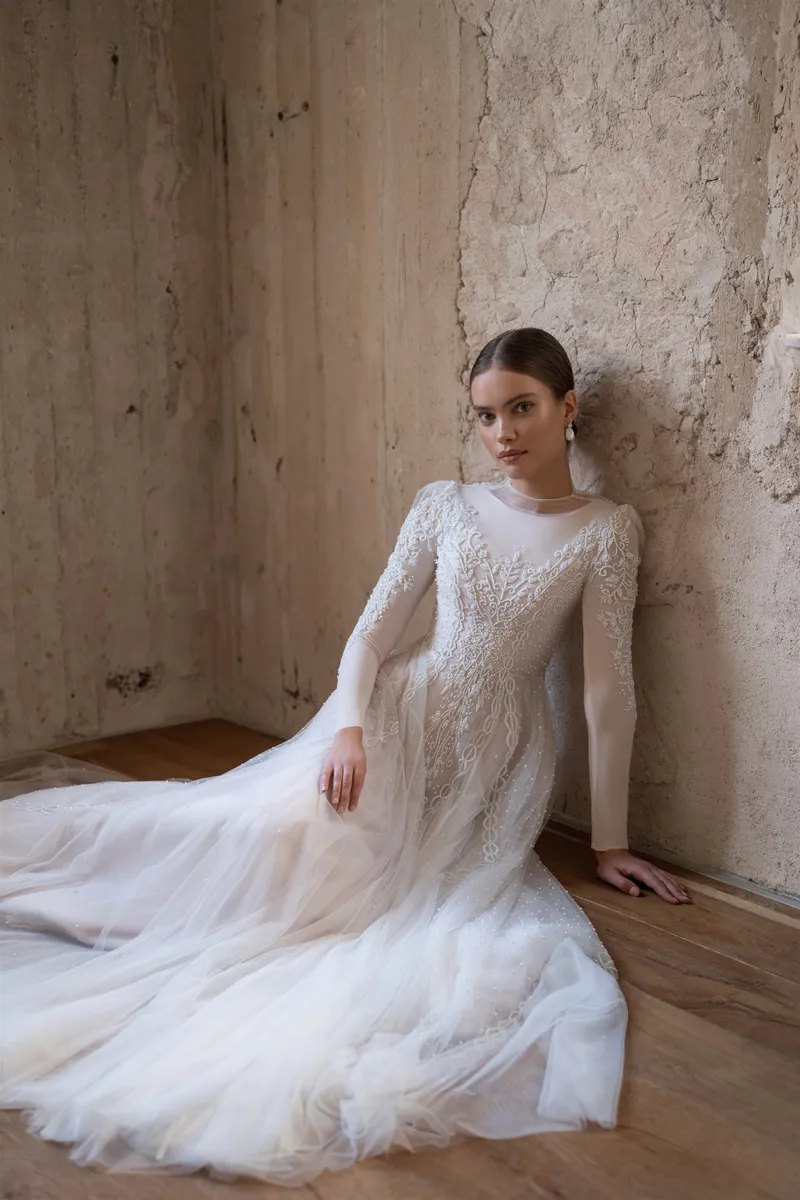
For modest gowns, Chantilly's lightness requires careful handling. A Chantilly long sleeve lined only with nude mesh will read as transparent — unacceptable for a truly modest gown. At AMALYA, Chantilly sleeves are lined with a second layer of opaque silk or fine cotton batiste that preserves the lace's delicate appearance from the outside while providing full coverage. The floral motifs float against the lining; the skin is never visible. This is how Chantilly becomes modest without losing its romance.

Alençon Lace — The Queen of Laces

Alençon lace — known throughout couture as the Queen of Lace — is the finest of the French needle laces, produced in Alençon, in Normandy, since the 17th century. It received royal patronage from Louis XIV, who established Alençon as the workshop for lace intended to rival Venetian production, and in 2010 the technique was inscribed on UNESCO's list of the Intangible Cultural Heritage of Humanity.

The defining characteristic of Alençon is its cordonnet — a heavy outlining thread that is stitched around each motif after the base mesh and pattern are worked, giving Alençon lace its distinctive raised, sculptural quality. Pull a piece of Alençon between your fingers and you will feel the texture: the cordonnet stands proud of the mesh, catching light differently than the interior of the motif. A true Alençon has scalloped edges — the scallops are integral to the design, not cut from a flat panel — and these scallops are one of the fastest ways to identify couture-grade lace.

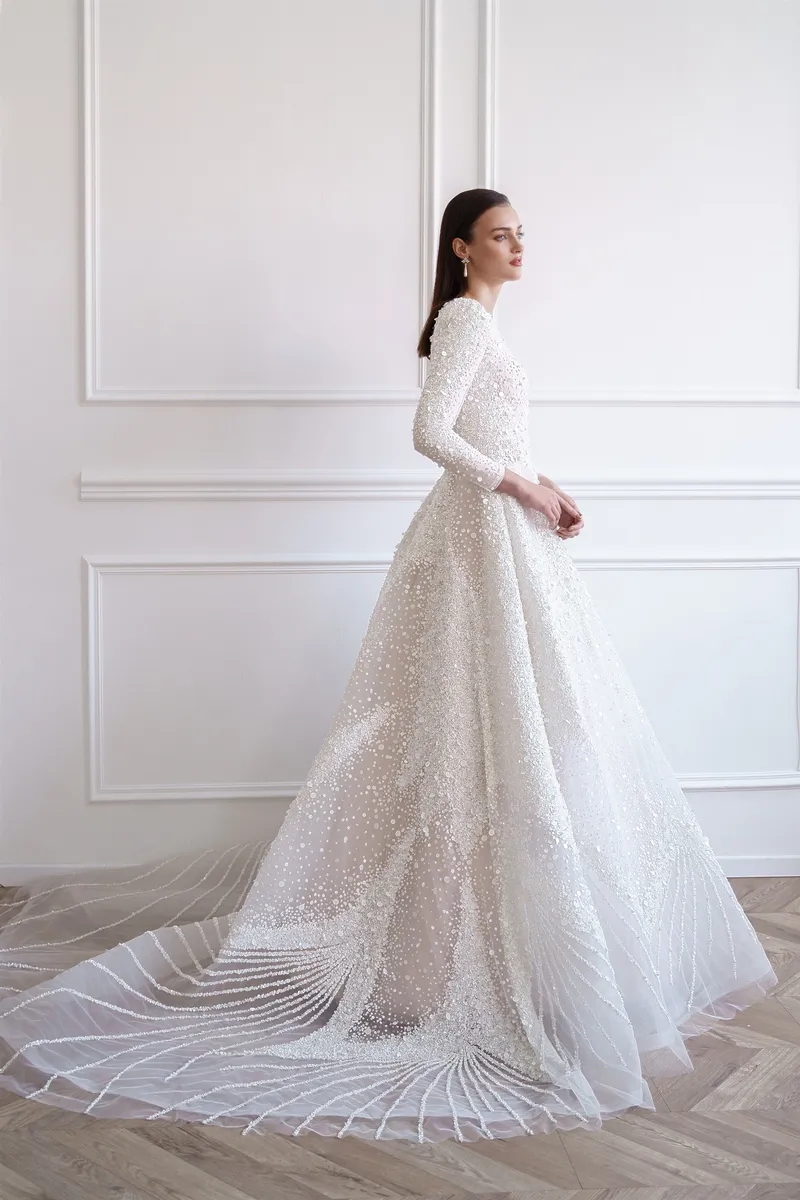
Alençon is the lace of statement pieces. It is substantial enough to be used as a bodice fabric on its own, sculpted to the figure without losing its structure. It is the preferred lace for cathedral trains — the corded pattern can be appliquéd to silk tulle and extended for meters without losing definition. It is, above all, the lace that holds beading beautifully: the cordonnet creates a natural scaffolding for pearls, quality beads, and crystals, so that each bead has a structured thread to anchor to rather than free-floating on mesh.

This is why Alençon has appeared in the most famous royal bridal gowns of the modern era. Grace Kelly's 1956 wedding dress, designed by Helen Rose, used 125-year-old rose point Alençon lace for its bodice and veil. Kate Middleton's 2011 gown by Sarah Burton for Alexander McQueen was built on hand-appliquéd Alençon motifs. Meghan Markle's veil carried a hand-embroidered border inspired by the same tradition. When a bride asks for a lace that feels like heirloom on the day she wears it, the answer is almost always Alençon.

At AMALYA, Alençon appears in our most architectural bodices and our most elaborately beaded trains. Because the corded structure supports the weight of hand-set beadwork, we can embed thousands of quality beads and pearls into an Alençon panel without the lace distorting — something no mesh-based lace can survive.

Guipure (Venice) Lace — Bold and Architectural

Guipure lace — often called Venetian lace or Venise — originated in 16th-century Venice and remains the boldest of the classical European laces. Unlike Chantilly and Alençon, guipure has no mesh background at all. The motifs are connected only to each other, by short thread bridges called *brides*, leaving open negative space between the patterns. The result is a lace that reads as pure pattern, almost sculptural, with an architectural clarity that no mesh-backed lace can match.

Guipure is heavy — often several times the weight per yard of Chantilly — and the motifs are typically worked in three dimensions, with raised florets, curling leaves, and relief details that cast their own shadows. A good guipure, laid flat on a table, will not lie completely flat; the dimensional motifs lift the fabric slightly off the surface. This dimensionality is why guipure photographs with such strong definition: every motif creates its own highlight and shadow.

For bridal design, guipure is the lace of structure and drama. It is the right choice for a sculpted bodice that needs to read as architecture rather than ornament. It makes extraordinary dramatic sleeves — full-length fitted sleeves, bell sleeves, or statement cap sleeves where the pattern must hold its shape rather than drape softly. It pairs brilliantly with modern-classic silhouettes, where a clean silk base gown is counterpointed by an elaborately patterned guipure overlay.

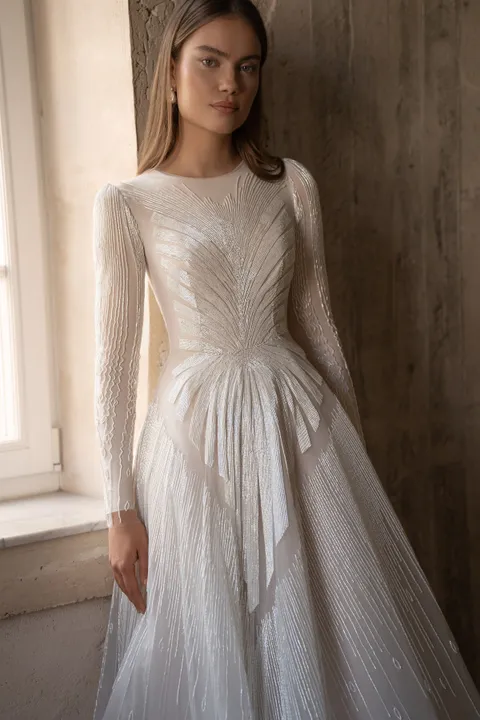
For modest brides, guipure offers a specific advantage: because it holds its own shape, it is ideal for high necklines. A guipure collar or yoke stands cleanly against the throat rather than collapsing inward; a guipure long sleeve retains its structure from shoulder to wrist. When lined properly, it creates full coverage that reads as couture geometry rather than concealment. AMALYA uses guipure when a bride wants a gown that makes an architectural statement — modest in coverage, but never quiet in presence.

Chemical and Schiffli Lace

A complete guide must address the laces that dominate the mass bridal market. Chemical lace — also called Schiffli embroidery after the Swiss Schiffli loom invented in the 1860s — is not technically a woven lace at all. The pattern is machine-embroidered onto a dissolvable base fabric; the base is then chemically dissolved, leaving only the embroidery behind to mimic the appearance of guipure.

At its best, high-end chemical lace is acceptable for linings, for hidden structural panels, and occasionally for secondary trims where its lower cost is justified. At its worst — and this is most of what the budget bridal market sells — chemical lace is stiff, plasticky, and unevenly patterned, with motifs that pixelate at close range. It resists dye, refuses to drape, and ages poorly. AMALYA does not use low-grade chemical lace in any visible part of a gown. When a bride lifts a sleeve to the light and the lace reads as flat, resinous, and dimensionless, she is almost certainly looking at cheap chemical lace masquerading as couture.

How to Evaluate Lace Quality

When a bride visits a couture studio and is handed a swatch of lace, she is usually looking for beauty — but a trained eye looks for six specific signs of quality. These are the same six checks we apply at AMALYA before accepting a yard of lace into the studio.

1. The hand-feel test. Pinch a small section of the lace between your thumb and index finger and release it. A couture-grade lace has body — it springs back, holds a gentle fold, and feels substantial without being stiff. A poor lace feels flimsy, paper-thin, or unnaturally rigid. Rub the lace between your fingers: fine cotton and silk warm to the touch; synthetic lace stays cool and slightly slick.

2. Pattern consistency across yardage. Unroll a meter of lace and walk along it. In a quality lace, the pattern repeats with perfect register — each motif is identical in size, in density, and in thread tension. In a poor lace, motifs drift: some are slightly larger, some have tighter thread, some are missing elements entirely. Hand-woven and heritage-loom laces have imperceptibly small human variations; mass-produced lace has machine faults that are visible at arm's length.

3. Scalloped edges. A true couture-grade lace is designed with a finished scalloped edge as part of the pattern, not cut from a flat panel. Look at the edge: if the scallops are integral to the weave, following the curves of the motifs themselves, the lace is bridal-grade. If the edge is a straight-cut line with pinking or fraying, the lace is meant for trim use only and is not a couture panel.

4. Thread fineness and consistency. Examine a single motif under bright light, ideally with a magnifier. The threads should be uniformly fine, with no thick-thin variations, no knots at the surface, and no loose fibers escaping the weave. In cotton and silk laces, the thread should have a subtle sheen; in viscose, a more pronounced one. Cloudy, matte, or uneven threads indicate low-grade fiber.

5. Backing and mesh density. For mesh-based laces like Chantilly, hold the lace against a uniform light source. The mesh should be even, hexagonal, and dense enough to support the motifs without sagging between them. Gaps in the mesh, irregular hexagons, or mesh that tears when gently stretched are all signs of compromise.

6. How it holds beading. This is the final test, and the one most invisible to untrained eyes. Place a heavy pearl or bead on the lace at a cordonnet or a dense motif section and observe what happens. A quality lace accepts the weight without distorting — the thread structure supports the bead, and a hand-set stitch will hold. A weak lace collapses under even a single pearl. This is why Alençon is used for heavily beaded gowns and why we never bead onto flimsy mesh lace.

Why Modest Brides Need Special Consideration

A strapless gown shows two square feet of lace; a modest long-sleeve, high-necked gown shows four times that — on the sleeves, the yoke, the cuffs, the neckline. For a modest bride, lace quality is not a detail. It is the most visible single decision in the entire gown.

This changes how lace must be chosen. First, lining is not optional — it is a design element in itself. At AMALYA, we do not line modest lace gowns with a single layer of nude tulle and call it done. We use a carefully chosen underlayer — typically a skin-tone matte silk or a fine cotton batiste — whose color is matched to the bride's own skin for invisibility, and whose weight is chosen so the lace pattern reads crisply against it.

Second, comfort matters across the entire day. A modest gown is worn for long ceremonies, photographs, dancing, and often a seated meal — sometimes twelve hours in total. A scratchy synthetic lace is unbearable against the inner wrist by hour three. Cotton and silk laces breathe; they soften with body heat; they do not irritate. This is a functional requirement, not a luxury.

Third, zero transparency is the standard. At AMALYA, every lace element is tested under direct studio lighting, under flash photography, and under natural sunlight before the gown is released. If the underlayer shows even slightly through the lace motifs, the lining is adjusted until coverage is complete. A modest gown cannot afford a single compromised camera angle.

The AMALYA Difference

What separates AMALYA's laces from what you will find in most bridal studios is exclusivity and oversight. Our patterns are commissioned from heritage Italian and French mill partners — pattern designs that are produced for us alone and for no other house. When you see a lace motif on an AMALYA gown, you will not find it in any other collection in the world.

Every lace we use is hand-woven or produced on heritage looms operated by master craftsmen — not chemical lace, not low-grade Schiffli, not the generic bridal-market laces that circulate between dozens of brands. Every yard is inspected by Amalya personally before it enters the cutting room. Every lace element is lined to meet modest coverage standards without exception. And every beaded lace panel is tested to support its beadwork without distortion before a single pearl is set.

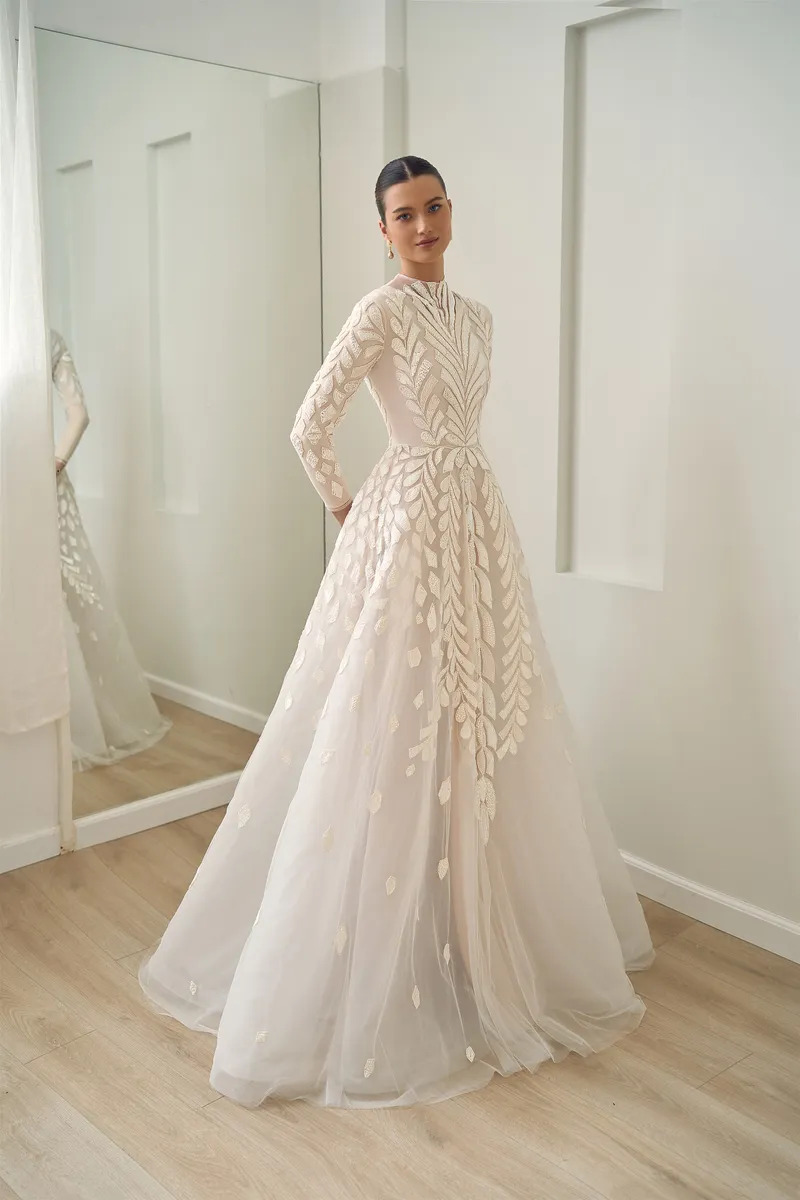
The result is a gown in which the lace is not a trim applied to the outside — it is the structural language of the design. Explore our current lace work across [our seasonal collections](/collections/) or [contact the studio](/contact/) to see swatches in person at a private consultation in Jerusalem.

Caring for Lace After the Wedding

A couture lace gown is an heirloom, and heirlooms require care. Storage should be flat or carefully rolled — never hung for long periods, as the weight of the beading will distort the lace over months. Use acid-free tissue between folds, and a breathable cotton garment bag rather than plastic, which traps moisture and yellows silk over time.

Cleaning must be specialized. Bridal lace should only be cleaned by a conservator experienced with couture garments — not a standard dry cleaner. Solvents and mechanical agitation will break cordonnet threads and loosen hand-set beads. If a stain occurs on the day, note it and leave it for the professional; home attempts almost always make damage permanent.

Preservation for heirloom is worth the investment. A professional preservation service will clean, stabilize, and box the gown in museum-grade materials, ready to be passed to a daughter or granddaughter. Laces woven today from fine cotton and silk will survive a century under proper storage — which is, after all, the entire point of commissioning couture.

Conclusion

Lace is the most visible, most loaded, and most meaningful material in a bridal gown — and on a modest gown, it is all three at once. Chantilly brings romance; Alençon brings heirloom gravity; guipure brings architecture. Chemical lace is the shortcut the couture world avoids. Quality reveals itself in body, pattern, edge, thread, mesh, and beading support — six signs a trained hand can read in sixty seconds.

If you are beginning the search for a modest wedding gown and want to see couture European laces in person — hand-woven, lined for modest coverage, set with quality beads and fine pearls — we invite you to [book a private consultation](/contact/) at our Jerusalem studio. Bring your questions; we will bring the swatches.

About the Author

Amalya Cohen
Amalya Cohen

Designer & Founder

Amalya Cohen understood from a young age that modest wedding dresses for Orthodox and religious brides deserved more — more artistry, more luxury, more attention to the craft. Read more about Amalya.